MAI-DxO: Microsoft's New Medical Tool with Stunning Results
Discover MAI-DxO, Microsoft's revolutionary AI-powered medical diagnostic tool, achieving an 85% success rate on complex cases, far exceeding human performance.
Microsoft recently published a new research paper on the advancement of its medical diagnostic system, MAI-DxO (Microsoft AI Diagnostic Orchestrator). Utilizing artificial intelligence and combining multiple language models, this system simulates a real medical team. The result? On complex cases, it achieves 85% correct diagnoses, more than four times the accuracy of experienced doctors during tests.
How MAI-DxO Works
This medical diagnostic system relies on a virtual panel of LLMs (large language models), each playing a well-defined role, much like a real team of doctors. Each model is responsible for a function: generating hypotheses, choosing which tests to perform, and analyzing results.
And the Results?
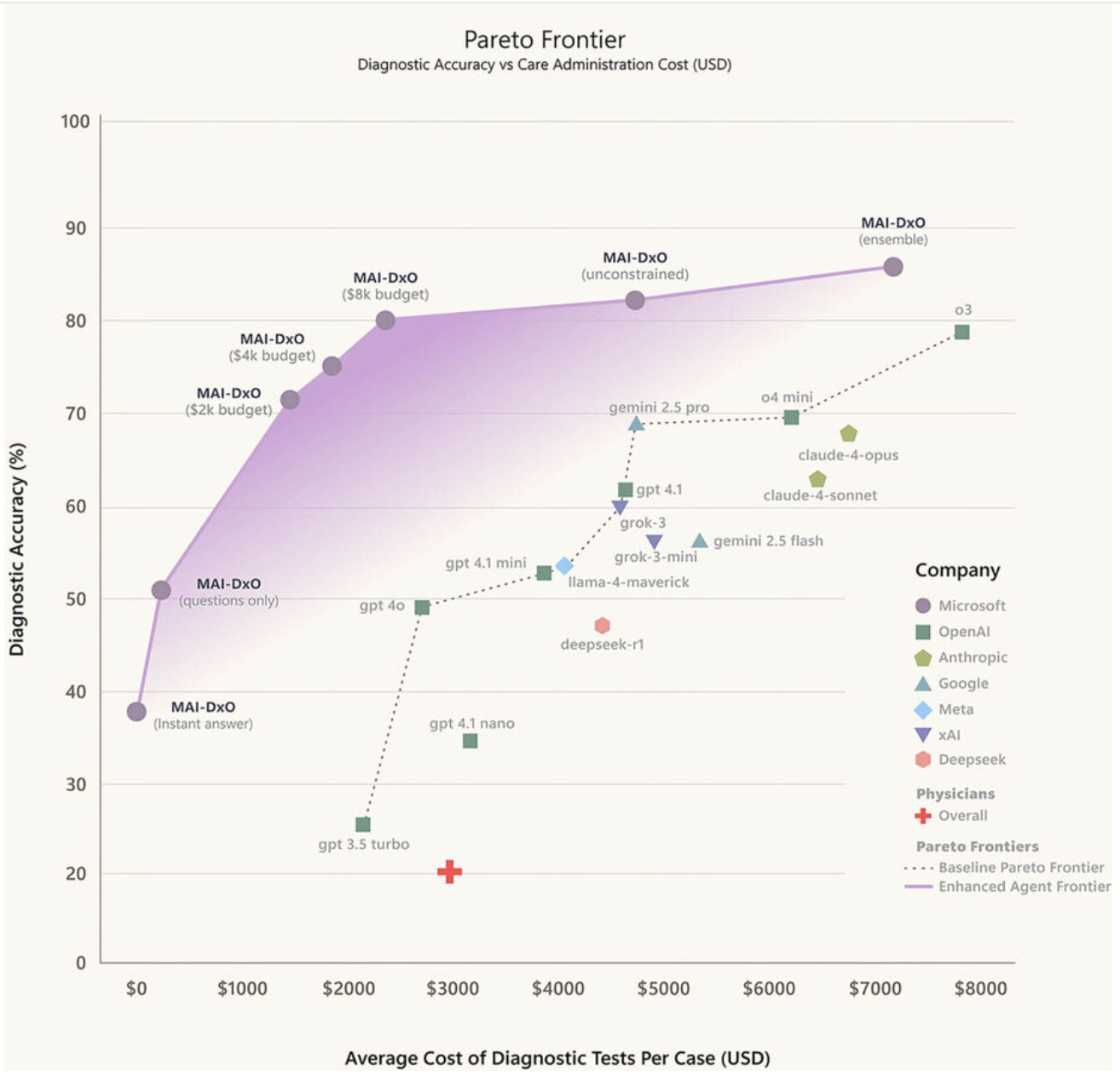
In this study, 304 complex clinical cases from the New England Journal of Medicine (NEJM) were used to compare the performance of the MAI-DxO system with that of a team of 21 experienced doctors from the United States and the United Kingdom. These cases are known for their difficulty and are often used to "trick" clinicians.
The results are impressive: MAI-DxO achieved a success rate of 85.5%, compared to 20% for the doctors. In parallel, the system helped reduce the cost of diagnostic tests by an average of 20%, by avoiding unnecessary tests thanks to its structured reasoning.
Limitations
Even though the results are promising, this project remains an exploratory study to date. MAI-DxO is not yet intended to replace doctors. It still requires many validations because the tested cases were very specific and selected for their complexity.
It is therefore too early to conclude that the system is systematically superior in real-world situations. Tests on more common medical cases, across diverse populations, would be necessary to evaluate its effectiveness on a large scale.
That said, MAI-DxO could become a valuable tool to support healthcare professionals. Its great advantage is the transparency of its reasoning, allowing doctors to follow each step and understand the decisions made by the AI.
Microsoft's Vision
With MAI-DxO, Microsoft aims to augment the capabilities of healthcare professionals, not replace them. The goal is to reduce diagnostic errors, while making quality care accessible on a large scale. This augmented AI approach marks an important step in the evolution of intelligent medical tools.
Conclusion
Generative artificial intelligence has seen spectacular development in recent years. Microsoft provides an impressive demonstration of this in the medical field with its MAI-DxO system, capable of simulating collective reasoning through the assembly of several AI models.
The results on complex cases are spectacular, but the system remains in the research phase. However, it opens up concrete prospects for the future of AI-assisted medical diagnosis.